

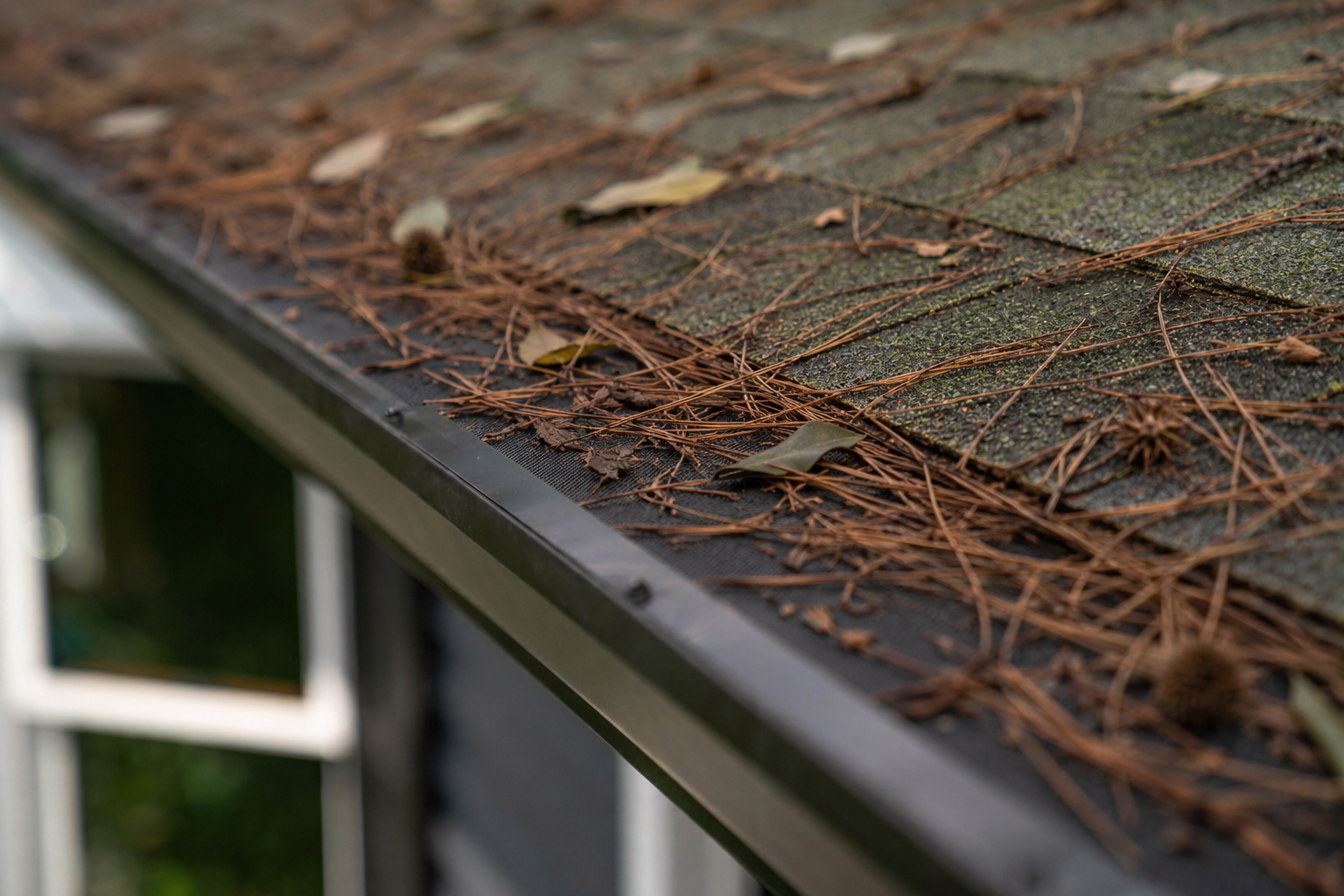
Gutters rarely fail all at once. They give you a long runway of small, easy-to-miss hints first: a faint streak here, a slight lean there, a patch of paint that looks a little off. The trouble is that most of these signs are quiet enough to walk past for months, right up until a storm turns a minor clog into water in your walls.
The good news is that once you know what to look for, the warning signs your gutters need cleaning or repair are easy to spot from the ground. Below are six of the most common, what each one actually means, and what to do about it before it gets expensive.
1. Dark Streaks Running Down the Outside of the Gutter
What it means: Those vertical “tiger stripes” are dirt and debris that overflowed the gutter and dried on the face. They are one of the clearest signs your gutters need cleaning, because they only appear when water has been spilling over the front edge instead of draining through the system.
What to do: Start with a thorough cleaning of the gutters and downspouts. If the streaks come back quickly after a cleaning, the slope or hangers may be off and the system needs a closer look.
2. Gutters Sagging or Pulling Away from the House
What it means: A gutter that dips in the middle or leans away from the fascia is carrying more weight than it should, usually from trapped water and wet debris, or from fasteners that have loosened over time. One frequent culprit is the old spike-and-ferrule method, where a long nail is driven through the gutter into the fascia. Those spikes work loose as the wood expands and contracts, which is why nearly every serious installer has moved away from them over the past decade. Gutters hung this way tend to pull away eventually, no matter how well they were installed. Left alone, the pitch gets worse, water pools, and the whole run can tear loose.
What to do: This is past the point of a simple cleaning. Sagging sections need to be rehung, refastened, or repaired so the gutter sits level and drains properly again. If your gutters were hung with spikes, it is worth having them assessed: when the gutters are still relatively young, we can often salvage them and rehang with hidden hangers, a sturdier bracket that fastens inside the gutter. When the spikes have already done their damage on the way out, replacement is usually the smarter long-term fix. Either way, it is one of the more common gutter problems to look for, and one of the easiest to catch early.
3. Peeling Paint, Rust, or Orange Streaking
What it means: Gutters are built to shed water, so paint that is bubbling or peeling, or metal that is rusting, tells you moisture is sitting where it shouldn’t. On the gutter itself it points to standing water inside the channel. On the siding, fascia, or trim below, it points to chronic overflow soaking the wood and finish.
What to do: Treat it as a signal, not just a cosmetic issue. Have the gutters cleaned and inspected. Rust spots and failing seams are clear signs of gutter damage that tend to spread, so catching them early keeps a small repair from becoming a full replacement.
4. Water Pooling Near the Foundation
What it means: Gutters exist to carry water away from your home. When you see puddles, eroded soil, or splashback against the foundation after it rains, the system is dumping water in exactly the wrong place. That usually traces back to a clog, a downspout that ends too close to the house, or a section draining the wrong direction.
What to do: Clear the gutters and downspouts first, then check that downspouts carry water several feet away from the foundation. Pooling water is worth acting on quickly, since foundation and basement repairs are far costlier than the gutter fix that prevents them.
5. Plants or Seedlings Growing in the Gutter
What it means: If something is sprouting up there, your gutters have collected enough decomposed debris to act like a planter box, and enough standing water to keep it alive. It is a sure sign the system has not drained properly in a long time.
What to do: This calls for a full hand-cleaning of the gutters and downspouts, not just a quick pass with a leaf blower. While the debris is out, it is a good moment to inspect for the rust, sagging, and loose seams that tend to develop underneath all that buildup.
6. You Can’t Remember the Last Time They Were Cleaned
What it means: If it has been more than a year, debris has almost certainly built up out of sight, even if everything looks fine from the curb. Most of the damage on this list starts quietly inside a gutter that nobody has checked in a while.
What to do: Get them inspected and cleaned. For most Los Angeles homes that means at least twice a year, and more often under heavy tree cover or in fire zones. Putting it on a schedule is the simplest way to keep small issues from turning into the bigger ones above.
Do My Gutters Need Repair or Replacement?
Here is the rule of thumb: If the gutters are structurally sound and the problem is debris, overflow, or a section that needs rehanging, you are usually looking at a cleaning or a targeted repair. If you are seeing widespread rust, separated seams, cracking, or sagging along most of the run, replacement often makes more sense than patching the same spots again and again.
The honest answer depends on what is happening up there, and that is hard to judge from the ground. A quick professional inspection will tell you which camp you are in before you spend money either way. If a few of these signs sound familiar, our gutter repair service can diagnose the issue and walk you through the right fix for your home.
Not Sure? We’ll Take a Look, Free.
Most of these warning signs are easy to miss and easy to underestimate, which is exactly why they are worth a second opinion. If you have spotted even one of them, reach out for a free estimate and we’ll tell you honestly whether it’s a simple clean, a quick repair, or nothing to worry about at all.